


Disabilities and Access and Functional Needs
Home » Plan & Prepare » New Jersey Residents » Disabilities and Access and Functional Needs
Emergency Management Resources for Individuals with Disabilities and Access and Functional Needs and the Organizations that Serve Them
“Register Ready – New Jersey’s Special Needs Registry for Disasters” gives residents with disabilities and access and functional needs – as well as their families, friends, and caregivers the opportunity to share important information with emergency response agencies. This helps responders better prepare and respond during disasters and other emergencies.
Register Ready Brochure
Emergency Planning for Individuals with Disabilities and Access and Functional Needs (DAFN)
The State of New Jersey has been recognized by Congress as a model when it comes to protecting our most vulnerable residents since they are more likely to be adversely affected during an emergency situation.
The New Jersey Office of Emergency Management (NJOEM) uses the definition outlined in the National Response Framework to address the needs of individuals with DAFN who may need extra support during adverse conditions. Disabilities and Access and Functional Needs (DAFN) is a function-based definition of disability and has replaced the “special needs” label. It reflects the capabilities of the individual—not the condition, label or medical diagnosis.
Examples of Individuals with DAFN

Individuals with DAFN have typically exhausted all other resources (family, neighbors, public transportation, etc.) but still need assistance when it comes to evacuation and/or sheltering before, during, and/or after a disaster. These individuals typically reside in single family homes or multiple family dwellings and are not residents of hospitals, health care facilities, or any community-based residences that are already subject to emergency planning requirements.
NJOEM is committed to following the whole community approach, which FEMA defines as “a means by which residents, emergency management practitioners, organizational and community leaders, and government officials can collectively understand and assess the needs of their respective communities and determine the best ways to organize and strengthen their assets, capacities, and interests.”
Staff ensure all phases of the emergency management process—mitigation, preparedness, response, and recovery—are inclusive of individuals with DAFN. It is our belief that everyone must be able to access mass care shelters, evacuate safely, and receive and understand emergency alerts and guidance.
We include advocates and human service providers in our planning efforts. Whole-community planning is just something we practice as a normal course of business, because every life matters.
Access and Functional Needs Coordinators
Aside from the NJOEM AFN Planner—who has many years of personal and professional experience—each County also has a dedicated County Access and Functional Needs Coordinator to help handle emergency management issues related DAFN.
The State and County Access and Functional Needs (AFN) Coordinators tirelessly work towards integrating individuals who have DAFN into all phases of the emergency management cycle and respond to disasters as needed. Additionally, they coordinate and engage with staff from the Offices of Emergency Management, Health, Human Services, and Aging as well as the Department of Children & Families, DAFN related agencies, and consumers among others in order to protect our vulnerable citizens.
The Core Advisory Group (CAG) concept was developed by FEMA to promote inclusive emergency management and the whole community approach. Most of the 21 counties in New Jersey have Core Advisory Groups. CAGs bring together emergency managers, first responders, public health officials, and others working in the field with individuals who have DAFN or work for DAFN agencies to enhance emergency management planning. Knowledge of the specific needs of this often overlooked group of citizens enables emergency managers to be more inclusive in their assistance.
CAGs can help jurisdictions develop an inclusive plan. People with DAFN range across every demographic sector of society, so it is important to understand the needs of local demographics of disability. This may include barrier-free and senior housing communities.
It is important to include members of the disability community in the planning process, as well as in drills and exercises. This helps to:
- Formulate solutions to problems before an actual emergency.
- Create a unified team able to quickly assess and communicate service gaps during an emergency.
- Prepare equipment, materials, and skilled personnel who are on the ready.
NJOEM also follows the CMIST Framework, which provides a set of considerations to assist with addressing DAFN-related matters during an emergency. These are:
Communication
Individuals who have limitations that interfere with the receipt of and response to information will need that information provided in accessible formats they can understand and use. They may not be able to hear verbal announcements, see directional signs, or understand how to get assistance due to hearing, vision, speech, cognitive, or intellectual limitations, and/or limited English proficiency. This support may include interpreters, translators, hearing aids, message boards, electronic devices and 508 compliant websites (meaning they are accessible to all users).
Maintaining Health
Individuals who are not self-sufficient or who do not have adequate support from caregivers, family, or friends may need assistance with: managing unstable, terminal or contagious conditions that require observation and ongoing treatment; managing intravenous therapy, tube feeding and vital signs; receiving dialysis, oxygen and suction administration; managing wounds; and operating power dependent equipment to sustain life. These individuals require the support of trained medical professionals.
Independence
Individuals requiring support to be independent in daily activities may lose this support during an emergency or a disaster. This support may include supplies, durable medical equipment, and attendants or caregivers.
Support, Safety and Self-determination
Before, during, and after an emergency, individuals may lose the support of caregivers, family, or friends and/or may be unable to cope in a new environment (particularly if they have autism, dementia, Alzheimer’s or psychiatric conditions, such as schizophrenia or intense anxiety). If separated from their caregivers, young children may be unable to identify themselves; and when in danger, they may lack the cognitive ability to assess the situation and react appropriately.
Transportation
Individuals who cannot drive or who do not have a vehicle may require transportation support for successful evacuation. This support may include accessible vehicles (e.g., vehicles that are lift-equipped or suitable for transporting individuals who use oxygen) or information about how and where to access mass transportation during an evacuation.
Register Ready for DAFN
Register Ready enables New Jersey residents with DAFN and their families, friends, caregivers and associates to enter relevant personal information into a database so emergency responders can enhance plans related to serving those with DAFN before, during or after a disaster or other emergency. Register Ready is a free, voluntary and confidential web-based program designed to identify the needs of people who have DAFN and may have difficulty getting to safety during an emergency.
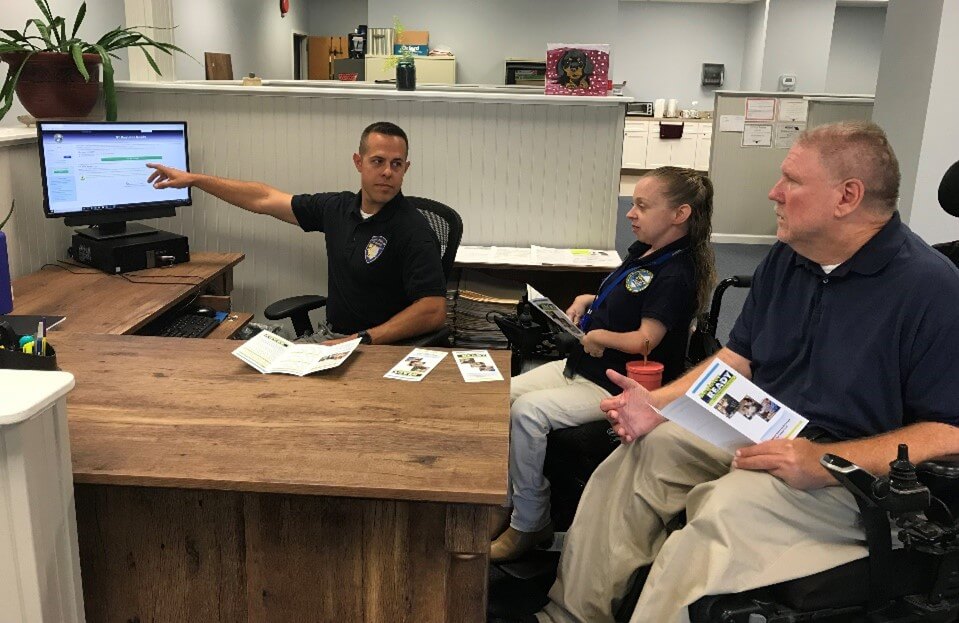
People with disabilities and access and functional needs (or their caregivers) and are encouraged to register by:
- Going to registerready.nj.gov
- Calling New Jersey’s toll-free 2-1-1 telephone hotline
- Operators will register callers, offer free translation, and provide TTY services for those with hearing impairments.
Brochures on Register Ready are available above in ten different languages. For more information, click here
Guidance and Resource List
The following is a list of resources that offer more information on DAFN emergency management and emergency preparedness.
ADA Best Practices Tool Kit for State and Local Governments
- Chapter 7- Emergency Management (Under Title II of the ADA)- ADA Tool Kit: Curb Ramps and Pedestrian Crossings Under Title II of the ADA
American Red Cross Guidance
- Disaster Safety for People with Disabilities – http://www.redcross.org/get-help/how-to-prepare-for-emergencies/disaster-safety-for-people-with-disabilities#Plan-Ahead
- Red Cross Action Checklist for People with Disabilities – http://www.redcross.org/news/article/ny/new-york/Red-Cross-Action-Checklist-for-People-with-Disabilities
- Disaster Preparedness for People with Disabilities (manual) – http://www.disastersrus.org/mydisasters/disability/disability.pdf
- American Red Cross & FEMA Brochure: Preparing for Disaster for People with Disabilities and other Special Needs – Food and Water (fema.gov)
Centers for Independent Living
Centers for Independent Living are community-based, consumer-driven organizations located in every county that provide information and referral, emergency preparedness training, skills training, advocacy, and a variety of services based on individual needs at no cost.
Communication Board
Use these boards (or cards) to communicate with someone in an emergency who is unable to speak or who speaks another language.
File of Life
This form can be found online for free. It is meant to be placed on one’s refrigerator so emergency responders can review the person’s medical information, allergies, medications, emergency contacts and more.
Hazard Information
Click here for information about hazards that impact New Jersey:
HHS emPOWER Map 3.0
The HHS emPOWER Map 3.0 gives every public health official, emergency manager, hospital, first responder, electric distribution company, and community member the ability to track the electricity-dependent Medicare population in their area.
If I Need Help
If I Need Help is a non-profit organization working to reunite those who are lost, disoriented, or cannot self-advocate with their loved ones and caregivers. They use QR code technology that can be accessed by a computer or cell phone to provide help, emergency ID, and peace of mind. They offer a free online member profile and Emergency Q&A that can be edited in real time and emailed or printed in an emergency. Their customizable ID products include ID cards & wearables, such as shoe/dog tags, patches, pins/clips, and apparel.
NJ Department of Human Services Office of Emergency Management
NJDHS OEM provides a variety of emergency preparedness services and training. For more information, visit:
Project Lifesaver
Project Lifesaver is a 501 (C)(3) community based, public safety, non-profit organization that provides law enforcement, fire/rescue, and caregivers with a program designed to protect, and when necessary, quickly locate individuals with cognitive disorders who are prone to the life-threatening behavior of wandering.
More Useful links
Contact Information
- If you have any questions or concerns, contact your County AFN Coordinator at: NJOEM County Coordinators | NJOEM
- NJOEM’s AFN Planner can be reached at: Kelly.Boyd@njsp.gov